The narrator’s relationship with the Communist female agent
The SympathizerThe unnamed narrator’s relationship with The Communist Agent turns on a contradiction between clandestine cooperation and public inaction: he is implicated in the intelligence operation that leads to her capture, then watches as she is tortured and sexually assaulted without stopping it. Her suffering becomes a central test of his later confession, which insists that guilt can arise not only from an act committed but also from the failure to act.
The intercepted list and concealed identities
The Communist Agent is Man’s courier, carrying a list of names that includes The unnamed narrator’s. When she is caught, she tries to swallow the paper rather than let it be seized. The unnamed narrator knows that he had passed the list to Man, while believing that The Communist Agent does not know his own true identity. She, however, knows who Man is. Their unequal knowledge binds her capture to the narrator’s covert role: he is not a stranger to the operation, even as he remains concealed from its courier.
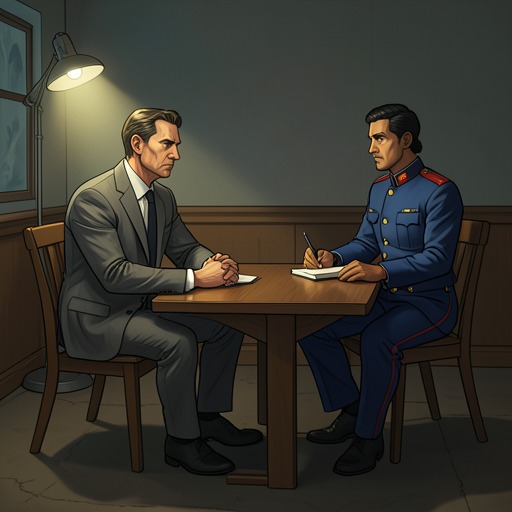
The written confession initially leaves her fate unspoken. During the later interrogation, the voice reading from the manuscript points out that the narrator has mentioned her repeatedly, described the list being pulled from her mouth and her hatred of him, but omitted what happened to her. He answers that he did nothing to her. The accusation turns on that defense: his failure to intervene, rather than direct physical participation in the assault, is the omission he is pressed to confess. The narrator’s silence about her fate therefore becomes part of the relationship itself, withholding the consequence of his presence until the interrogation forces him to remember it.
The witness to her assault
In the movie theater, the captured agent is stripped and tied to a table while three policemen take turns assaulting her. The narrator is present with Claude, who calls himself an adviser, and the crapulent major, who says the General wants to know how the names were obtained. The narrator objects that the abuse is wrong and asks the officers to leave him alone with her, but his request is dismissed. The policemen treat the demand for information as permission for sexual violence; their question about her name becomes part of the degradation, and her answer—that her surname is Viet and her given name Nam—provokes their laughter rather than interrupting the assault.
The narrator remains in the room, holding a bottle of soda that grows warm in his hand. He watches the officers rape the agent in turn. As they jostle around the table, her legs thrash; by the time the oldest policeman takes his turn, she no longer screams. She looks directly toward the narrator, but he has the impression that pain has made her unable to see him. The scene makes his presence consequential without making him the physical perpetrator: he protests, yet neither his protest nor his position in the room stops what is happening.
Afterward, the policemen wash the agent and the table, and the narrator recalls that he must have stepped in the spilled soda. Left naked on the table, she becomes silent. The men leave a drained bottle inside her body and treat it as a crude joke, while Claude disclaims having taught them that particular abuse. The narrator’s memory preserves these details even though his written confession had not disclosed her fate. When the later interrogation makes him face the omission, the distinction he had relied on—between doing harm and doing nothing—collapses: his failure to intervene becomes the guilt he must acknowledge.
The failure to act and its aftermath
The later interrogation reframes the narrator’s place in the assault as a failure of rescue, not merely a failure to disclose what he witnessed. In his fractured perception, the Commandant reminds him that the Communist Agent had been willing to give her life to save the commissar, while he had not been willing to risk himself to save her. The accusation makes their unequal positions explicit: she acted with a willingness to sacrifice herself for another, whereas he remained a spectator despite recognizing that what was happening was wrong.
The Communist Agent survives, but the Commandant says that when she was liberated she could not walk. The commissar adds that her body may have been broken but her spirit was not. These details overturn the narrator’s earlier claim that he did nothing: he did not inflict the assault, but his inaction left him implicated in its human cost. Under interrogation he acknowledges that he is being punished not only for acts he committed but for the act he failed to perform. Her suffering thus becomes the measure against which his self-description as a witness is tested, and the silence in his confession becomes evidence of a moral failure he had tried to leave unnamed.
Dissociation, memory, and the limits of witness
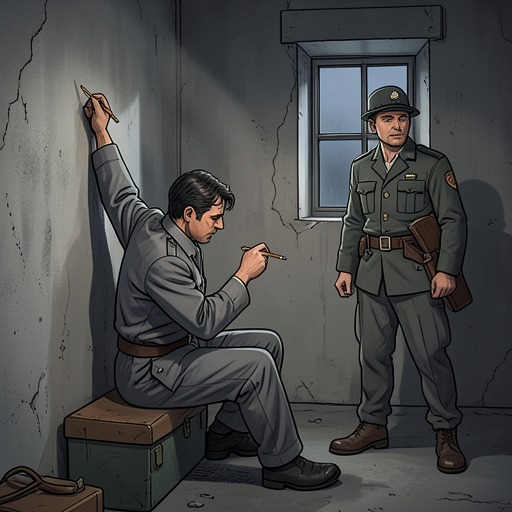
The recovered assault scene returns inside the narrator’s interrogation as an answer to a question his written confession had evaded. The shift from manuscript to questioning makes memory itself part of the relationship: the account was present in fragments, but the narrator had not named what those fragments meant or admitted what his watching cost the agent. As interrogation continues, his consciousness separates from his tormented body, hovering above it as if observing an experiment. That distance offers no escape from responsibility. From that divided vantage, he sees himself acknowledge that he is being punished for what he failed to do, and the agent’s suffering becomes the event that makes his silence legible as guilt.
The scene’s moral distinctions remain important. The policemen commit the assault; the narrator does not become its physical perpetrator simply because he witnessed it. But his objection and his presence do not protect the agent, and the interrogation refuses to let his limited protest stand as an answer to her abandonment. By placing his inaction beside her willingness to sacrifice herself for another, the narrative tests the difference between recognizing violence and accepting responsibility in its presence. Her survival does not undo the harm or resolve that test: it leaves the narrator with a living consequence he had tried to keep outside his confession.